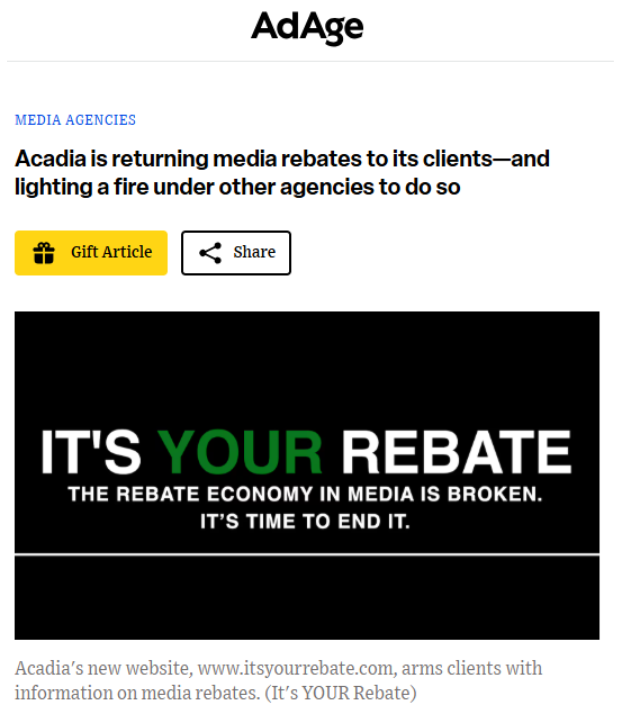
It's Your Rebate
The Rebate EconomyIn Media Is Broken
It’s Timeto End It

Brands should not engage with Agencies that take rebates without knowing all the facts
The Rebate Economy In Media Is Broken. It’s Time to End It.
There is an uncomfortable truth the advertising industry has avoided for far too long: a meaningful portion of agency profitability today is not earned through strategy, creativity, or performance, but through rebates quietly extracted from client media dollars.
That era must end. Today.
Here’s how the system works. Agencies aggregate millions and billions of dollars in client media spend and deploy that capital across platforms and publishers like MNTN, Meta, MIQ, StackAdapt, Hulu, NBC, Netflix, Disney, Yahoo, Google, NY Times, Paramount, DSPs, streaming publishers, retail media networks, and a long tail of partners. In return for that scale, publishers often offer rebates, incentives, or volume-based credits. To be clear: publishers are allowed to offer rebates. If I were them, I would too. That is not the problem.
The problem is what happens next.
In many cases, agencies keep those rebates as profit, rather than returning them to the clients whose dollars generated them in the first place. This isn’t optimization. It’s appropriation.
Let me make three points plainly.
First, rebates do not belong to agencies.
Agencies are stewards of client capital. Fiduciaries. The rebate only exists because the client’s money was spent. If a publisher offers a volume-based incentive derived from pooled client dollars, that incentive should flow back to those clients on a pro rata basis. Anything else violates the spirit, if not always the letter of stewardship.
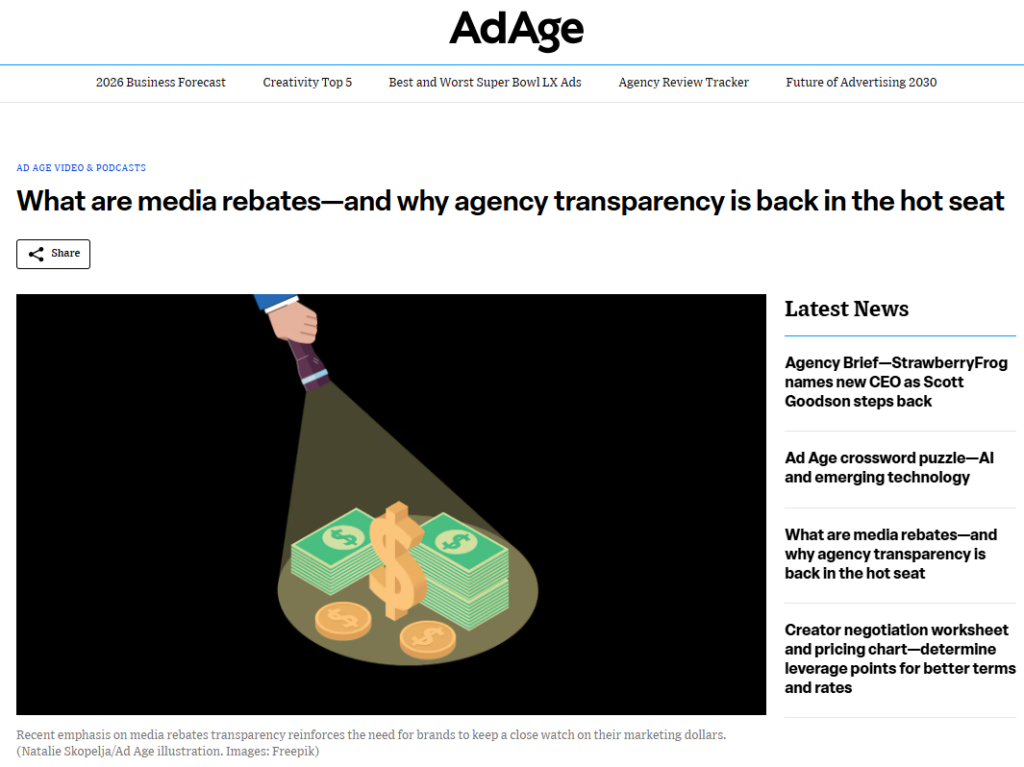
This isn’t theoretical. Multiple industry studies estimate that rebates and “non-transparent incentives” represent 3–10% of total digital media spend globally. With global digital ad spend now exceeding $600 billion, that puts the rebate economy conservatively in the tens of billions of dollars annually. Even a mid-sized agency managing $500 million in billings could be generating $5–25 million a year in rebate-driven margin, often undisclosed.
Second, many agencies are structurally dependent on rebates.
This is the most uncomfortable part of the conversation, and the one few want to have publicly. As media fees compressed over the past decade, rebates quietly became a backdoor margin engine. According to industry benchmarking data, average agency operating margins now hover between 8–12%, yet rebate income can account for 30–50% of total agency profit in some models.
Remove that income stream abruptly, and yes some agencies would face existential risk. But that reality doesn’t justify the practice. It indicts it. If an agency’s business model collapses without monetizing client money indirectly, then the model itself is broken.
Third, clients largely don’t know this is happening.
Not because brands are naïve but because the system is opaque by design. Contracts are vague. Language is “commercially flexible.” Procurement teams focus on fees, not incentives. Marketers assume alignment. And few clients ever ask publishers directly whether their spend is part of a rebate pool.
That lack of scrutiny has consequences. Some holding companies and large independents are estimated to earn hundreds of millions of dollars annually from rebates, incentives, and principal-based trading structures often without clear disclosure. Meanwhile, brands are under relentless pressure to prove ROI, manage budgets, and justify every incremental dollar.